Transit-Oriented Development: My Recommendations

This is my tenth and final blog post on the topic of whether or not transit-oriented development should replace sprawling suburban development in Prince George’s County, Maryland in regards to gentrification.  I have researched what gentrification is, the positive and negative effects of gentrification, and potential solutions to gentrification. All of this research has been aimed at providing you, the one who is afraid that gentrification may displace you from your neighborhood, with an idea of how gentrification works, mechanisms to stop its bad effects, and ultimately whether or not you should be worried about it. My final recommendation is this: Transit-oriented development should be constructed in areas that can support it with the addition of programs and mechanisms adopted from professional recommendations and from other jurisdiction’s strategies. In areas where there is not enough demand, transit-oriented development should not be constructed. In addition, in areas that do not consider the following mechanisms to avoid displacement, transit-oriented development should not be constructed.

One strategy, as I discussed in this post, is to adopt two smart growth strategies from other areas including Montgomery County, Maryland’s Moderately Priced Dwelling Unit Program, which sets aside a specific percentage of housing in a new development to be kept at affordable rates, as well as Portland Oregon’s Urban Growth Boundary, which sets density standards for new developments. The Strategy in Portland would allow there to be enough concentration of people to meet the demand required for transit-oriented development to be successful. The problem with projects like this failing is that while gentrification would not be an issue, other businesses and employers would not want to locate in an area that they saw could not sustain a single project of this sort. In that sense, failed projects could mean less employment opportunities for those vulnerable to gentrification (meaning low-income households). The Moderately priced dwelling units, on the other hand would allow renters to remain in new developments in these transit-oriented centers, though it would not solve rent spikes in areas around the development, which you are likely living in if you are reading this. In this sense, these Smart Growth strategies are to be implemented when the projects break ground.

More urgent is the need for community strategies to avoid gentrification before the project even gets started. These are strategies that should be implemented as soon as possible because the DC area continues to grow and it may only be a matter of time before projects like these start coming to Prince George’s County as studies show Prince George’s County is loosing out. The strategies, as detailed in this post, stabilizing existing renters, controlling land for community development, build income and asset creation, and strategies to finance these strategies. My recommendation is to adopt at minimum one from each category, but more is always better so long as they do not take away from other strategies.

In summary, my recommendation is to construct transit-oriented development where demand is met or where demand can be met through Smart Growth to density areas of interest with the stipulation that community strategies to prevent displacement be implemented along with Smart Growth inclusionary strategies. I hope you have enjoyed this blog! I also hope that this blog has brought some insight into why you may not be displaced if or when this development comes to your area of Prince George’s County. If you would like addition readings, please refer to my readings to consider page. It’s been fun! Thank you for taking the time to read my blog!
Smart Growth Strategies to Compare

In my last post, I discussed Maryland’s Smart Growth Strategy in relation to affordable housing. Maryland was the first state to implement Smart Growth strategies but other states adopted similar principles. Maryland started out with statewide Smart Growth Laws but in the early 2000s shifted to allowing counties enact Smart Growth principles. If you’re a low-income person living in Prince Georges County, you may be wondering why this matters. To put it simply, Smart Growth encourages development that allows affordable housing to coexist with higher cost housing. So if a transit-oriented development project was built in Prince George’s County and property values increased, you might have to move, but in Montgomery County you would not!

Before looking at other states, it is important to compare strategies at the county level. Montgomery County is a leader in preserving affordable housing in new developments. Why? Because of their Moderately Priced Dwelling Units Program. According to their website,  the Moderately Priced Dwelling Units Program is a law that requires 12.5% to 15% of all units located in a new development of 20 units or greater must be set aside for low and moderate income families. It also requires that 40% of the units be offered to non-profits like the Housing Opportunities commission. Prince George’s County has nothing like this! According to Urban Sprawl: A Comprehensive Reference Guide by David C. Soule, it has resulted in Montgomery County being one of the most racially and economically diverse counties in the nation.

While the Moderately Priced Dwelling Units Program is successful in providing and preserving the price of low and moderate income homes, it has mixed social success. According to James Cohen, the Director of the Urban Studies and Preservation Department at the University of Maryland, while developers cooperate with the program, they often segregate housing by doing things like placing low income housing behind a line of evergreen trees or in an isolated section. For me, this is a very worrisome issue because it means economic classes are not integrating and that causes social strains as I spoke about in this post

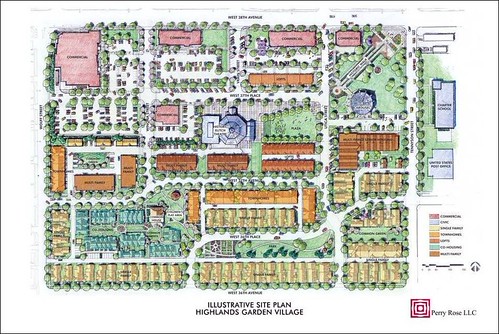
site plan for HGV (courtesy of Perry Rose)

An examaple of inclusionary housing plan from Denver. Source: http://switchboard.nrdc.org/blogs/kbenfield/a_close-up_look_at_a_smart_gro.html

Smart Growth in other states is a bit different. David C. Soule’s book has a comprehensive comparison of different inclusive zoning strategies starting with Montgomery County’s being labeled as the leader. Only 5% of jurisdictions include this type of development. Oregon uses what they call an Urban Growth Boundary, where a geographical area is placed around a city where development must be contained and new developments must be at a certain level of density. Within these boundaries, a particular percentage of housing must be kept affordable depending on the economic makeup of the jurisdiction. In California, many jurisdictions offer financial incentives to developers who set aside a portion of their units for affordable housing. According to this article by Yan Song, Florida adopted the Urban Service Area boundary similar to Oregans’s Urban Growth Boundary, but instead of placing density thresholds, it acts just as a way to stop the geographic spread of growth. By doing this, affordable housing is placed within a boundary but not necessarily within new developments.

There are many other strategies for Smart Growth and for inclusionary zoning (zoning which includes affordable housing) which I feel Prince George’s County could adopt for residents like you who may not be able to afford increased rents. In my next post, I will talk about my recommendations for Prince George’s County!

Smart Growth: An Answer to Gentrification?

In my previous post,  I talked about ways to avoid the negative effects of gentrification. While all of the examples given were very encouraging for anyone who is fearing displacement by gentrification in Prince George’s County, I wanted to know if there were any programs that combined different strategies into one cohesive initiative. After doing an interview with someone knowledgeable on the subject, I found something that can really make Prince Georges County, where the Purple Line and other transit-oriented projects may be constructed, a place where conditions for gentrification and subsequent displacement do not occur. That something is Smart Growth. I interviewed the director of the Urban Studies and Planning Department at the University of Maryland, James Cohen. When I asked him about what can be done to negate the negative affects of gentrification, we began to discuss Smart Growth.

I interviewed the director of the Urban Studies and Planning Department at the University of Maryland, James Cohen. When I asked him about what can be done to  negate the negative affects of gentrification, we began to discuss Smart Growth. What is Smart Growth? According to the Maryland Department of Planning, Smart Growth is  “…new development and redevelopment in areas that have existing or planned infrastructure to avoid sprawl. Smart growth is sustainable and is characterized by compact, transit-oriented, bicycle-friendly land use, with neighborhood schools, walkable streets, mixed-use development and a wide range of housing choices. Its purpose is to conserve valuable natural resources through the efficient use of land, water and air; create a sense of community and place; expand transportation, employment, and housing choices; distribute the costs and benefits of development in an equitable manner; and promote public health.” All of this is in conjunction with promoting the positive aspects of transit-oriented development and about supporting existing communities that could be impacted by gentrification. What this means for you as a low-income resident of Prince Georges County is that Smart Growth promotes equal access to housing, communities, and the environment.

A map of Maryland showing the future of Maryland land use. Smart Growhtt aims to curb sprawl. Source: http://thecityfix.com/blog/can-maryland-curb-the-red-dots/

According to an article from the Idaho Law Review, Maryland’s Smart Growth plan began as a way to address five key issues. Those include pragmatic balance (having a balance of development areas and environmental areas), urban containment (focus areas for growth), infrastructure finance (where the money comes from), land conservation (influencing local zoning to protect the environment), and statuary framework (a system for measuring progress of the program).   Over the years, Smart Growth has changed dramatically as we can see in this document about the future of Maryland’s Smart Growth. In looking under the section titled “Revitalizing Communities”, we can see several strategies for making neighborhoods stronger while supporting existing communities with programs like Community Development Block Grants, which expand affordable housing. Smart Growth has seen many successes in Maryland.

According to this article from SmartGrowthAmerica, councilman Eric Olsen has been consistent on aiding transit oriented development and keeping as residents in PG county connected to development aimed at connecting people with transit, including complete streets. Complete streets is a policy measure in the county that ensures the connections of non-motorized access (bikeways, walkways, pathways) to transportation facilities. The article even mentions how ridership of the shuttles at the University of Maryland has increased significantly since the implementation of Smart Growth strategies.

You may be wondering what the point of this blog is for implications with PG county if this program already exists. The answer is simple: just look at the College Park Metro station. It is isolated and is not transit-oriented. Furthermore, Smart Growth is not perfect. In my next blog I will discuss why.

Are There Ways to Avoid the Negatives of Gentrification?

In my last posts, I discussed the good and bad effects of gentrification. I gathered from these posts that gentrification is not a simple process and cannot fall into one category of ‘good’ or ‘bad’.  As such, it’s not an easy fix! I’m thinking that there must be a way to avoid the harmful effects of gentrification while retaining the good. I think it is important for a University of Maryland student like myself to look at things from all perspectives because when I enter the urban planning field, I want to consider all aspects.

If you haven’t followed my blog through each post, you may be wondering how this ties in with whether or not suburban areas should construct transit oriented development. To put it simply, it seems that transit-oriented development is associated with gentrification because rents increase in nearby areas. This is important because renters of residential and business properties near these areas will have to pay more to continue living in that area. If you are one of those people, don’t fret! There are solutions!

According to Kalima Rose Race, Poverty & the Environment in an article titled “Race, Poverty & the Environment”, there are four strategies to respond to and avoid the displacement of residents. The first and foremost is a detailed strategic assessment of the gentrification process. Defining the observable problem is a must for a solution to be agreed up and implemented. The four strategies are as followed:

1. Kalima states that the first strategy is stabilizing existing renters. This means providing assistance to renters by making prices more accessible. Specific strategies for things like this include providing rental assistance emergency funds, removing discriminatory barriers in law and practices, creating limited-equity housing programs and other resident-controlled housing programs, and preserving affordable housing through non-profit, public, and private sectors. What does this all mean? It means giving residents opportunities to keep their affordable rents.

source: http://muconf.missouri.edu/commdevelopmentacademy/

2. The second strategy is controlling land for community development. This refers to creating equitable development, done through land use and policies in tax and zoning. Examples of this include inclusionary zoning ordinances, mixed use and transit-oriented development, and density provisions. It’s interesting that she mentioned transit-oriented development when it is known to cause gentrification. I believe it is a reference to zoning within and around transit-oriented development to mitigate negative effects of gentrification.

3.  The third strategy is to build income and assets creation. This means providing services and employment opportunities for local residents. Services include things such as daycare, transportation, retail, and healthcare. Employment opportunities refers specifically to implementing local-hire and living-wage provisions.

4. The very last strategy is developing financing strategies. This entails strategies to fund the three aforementioned strategies.  These vary greatly and can be things like funds from business associations, fees from commercial developments, tax abatement, tax increment financing and eminent domain, credits, and deferments. Of course, there are many others!

So, it looks there there are plenty of strategies to help avoid the displacement of people due to gentrification caused by the implementation of transit-oriented development. This is especially true because planning these strategies before the rising prices has started makes it far easier! So if you are worried about being displaced, do not worry! There are solutions!

Gentrification: The Good Effects

In my last post, I discussed the negative effects of gentrification. In this post, I will talk about the good effects. The good effects of gentrification could help guide future discussions of why adding transit oriented development to suburban areas can provide positive change in how the neighborhood is economically and socially shifted. If you are a low income resident in College Park concerned with the upcoming Purple Line,  you may at this point be scared or angry. But there are upsides to gentrification.

One very interesting article comes from Daniel Sullivan from the Portland State University in which people were surveyed in gentrifying neighborhoods. What was found is that of the people surveyed, which included both new and longstanding residents, 62% felt their neighborhood improved, 33.5% felt their neighborhood remained the same, and 4.6% felt their neighborhood decline. 77% felt their neighborhood would improve over time. This article also found that regardless of levels of educational attainment, positive responses to neighborhood changes were recorded. What this tells me is that non-gentrifiers (people who have been in the neighborhood before gentrification) are not overall unhappy with neighborhood transition due to gentrification, which is something that is opposite of what most people think of in terms of gentrification. It’s possible that the same sentiments will be felt in College Park near new stations. This is an important conclusion because quality of life seems to improve.

Clifton Heights

A gentrifying neighborhood in Cincinnati source: http://www.urbancincy.com/2013/12/gentrification-occurring-in-more-cincinnati-neighborhoods-than-just-those-in-center-city/

Another positive of gentrification is job creation, but it comes with a catch. According to Lester and Hartley in their article from the Regional Science and Urban Economics Journal, job growth is reported in gentrifying neighborhoods. The catch, however, is that this growth is in service sector jobs and a decline in manufacturing and producing jobs. Industries that expanded faster also include businesses that serve the neighborhood such as restaurants. What this seems to say is that there is economic growth in gentrifying areas, which attract more people. However, traditionally blue-collar jobs that are often associated with poorer neighborhoods where gentrification occurs see declines in these neighborhoods. This can lead to displacement. However, I am thinking that if transportation networks were efficient enough, relocation of jobs would not be a reason for displacement. Also, the fact that restaurants become more common is a good thing because it means that gentrification brings in amenities to neighborhoods that previously had a lack of. Other amenities like entertainment and grocery stores therefore are likely to follow gentrification and bring in more investment and residents, expanding a city’s tax base.  On a side note, Hartley also found that credit scores of longstanding residents improved in gentrifying neighborhoods. It seems again that quality of life improvements can be attained from transit-oriented development and gentrification.

Another benefit is with crime. According to a study from Justice Quarterly, more coffee shops in a neighborhood is correlated with reductions in homicides and robbery. While correlation does not mean causation, it is a finding that makes gentrification seem like a positive process for crime. To be fair, though, it is worthy to mention that other studies have found that assault increases in gentrifying neighborhoods. So, it’s a rather mixed bag when it comes to crime, but it seems that over time, crime decreases overall in gentrifying neighborhoods. Everyone benefits when crime is reduced.

From the original research topic of whether or not transit-oriented development should be constructed in suburban areas, it looks like the side effect of gentrification could have positive effects that together with the improved efficiency, environmental improvement, and economic growth could do wonders for a community, including low-income residents in areas such as College Park.

Gentrification: The Bad Effects

In my last post, I introduced the topic of gentrification. The overall question I am trying to answer is this: Should suburban areas consider transit-oriented development in the U.S. with knowledge that gentrification may occur? I need to first understand the pros of gentrification, its cons, whether or not it is avoidable with growth, what is done to prevent it, and how all of the research I am doing can clarify whether or not suburban planning organizations should be constructing transit-oriented development.

For this post, I will start with the bad. If you are a renter in a low-income area, this post could be alarming! Especially if you are in the College Park area and you are worried about the Purple Line’s introduction (The Purple Line is a light rail that will go through College Park). To put into context the importance of gentrification when considering urban and suburban development, I think it is wise to see it in terms of sustainability. According to the Mark Roseland’s Toward Sustainable Communities, there are three core elements of sustainable development: environmental, economic, and social. Gentrification falls under the social element and economic of sustainable development, while transit oriented development falls under the environmental and economic. Because gentrification affects prices and culture, these two elements make it an unavoidable topic.

The biggest negative is that people are displaced. This means forced to move. According to Allan Greenblatt from CQ Researcher, gentrification brings rent increases which force those renting housing and commercial spaces to move elsewhere. This is where social issues are consequential of economic change. That is, when rents increase businesses and people have to to go to new neighborhoods. Not only is there a cultural clash between incoming residents and longstanding residents, but when the longstanding residents move out, there is again a cultural difference between them and the new neighborhood they have moved to. This is a concern of everyone in the metropolitan area because people must move elsewhere once they’ve been displaced.

Washington DC gentrification map 2000 census - present 2015 02

Census tracts in Washington, D.C. that have gentrified between 2000 and 2015. Source:http://batesareacivicassociation.org/2015/02/03/the-census-tract-that-includes-the-bates-area-is-gentrified/

Another major issue is identity. When new cultural groups move into a neighborhood, longstanding neighbors often share a sentiment that they are loosing what was theirs. According to the Guardian, for example, one woman felt that the neighborhood now “belongs to the rich”. Many sources indicate that a prominent sentiment in all people involved in a neighborhood shift including longstanding residents and newcomers feel a sense of “otherness”. That is, they don’t feel a sense of understanding between groups and a sense of unity. This can breed a tense relationship between different groups, which is important because feeling safe is important for quality of life.

According to SFGate, in San Francisco, gentrification has induced a lower enrollment in schools because families must move. This same theme applies to Washington, D.C. As the demographic between 18 and 34 improved, the number of children decreased dramatically according to Datatools.urban.org. Part of this is because what draws millenials, which is the current demographic of 18 to 34-year-olds, to cities are things like nightlife and restaurants which are not priorities for families. As a result, nearly all development currently in U.S. cities are geared towards millenials.

Another very interesting idea coming from the CQ Research article is that when people are displaced away from walkable areas or transportation options, they are forced to rely on cars. This concept would mean that the environmental element of sustainability is effected negatively. The environmental affects are the least important problem with gentrification however. This is particularly true when you consider how daily community socialization is disrupted from displacement of residents and businesses. If gentrification caused more cars on the road, transit-oriented development could potentially be counter productive! That’s pretty shocking!

There is half of the story. Gentrification is a complex process that affects many facets of society. This post detailed the bad, but let’s look at the good in my next post!

Does Transit-Oriented Development Induce Gentrification?

In my lasts three posts, I discussed what transit-oriented development is, how it fits in context with historical development patterns of the United States, and the good and bad it brings. In searching for the pros and cons of this type of development, the consequence of gentrification was a surprising one to me because I never really thought about it in this light. The remaining posts in my blog will be dedicated to the relationship between transit-oriented development and gentrification. You may be asking yourself “what is gentrification?” The definition of gentrification according to dictionary.reference.com is “the buying and renovation of houses and stores in deteriorated urban neighborhoods by upper- or middle-income families or individuals, thus improving property values but often displacing low-income families and small businesses.” What I find so intriguing about this definition is that it seems to include both positive and negative aspects depending on one’s point of view. On one hand, it could be seen as good because restoring urban neighborhoods can add an economic benefit to a city while also preserving historic architecture. On the other hand, it is seen as bad because it can displace low-income families and small businesses. While this is a common definition of the term, I know there is a lot of controversy surrounding its effects in real life. Renovations that could be considered gentrification in the Over-The-Rhine neighborhood of Cincinnati, Ohio. Source: http://mail.findyourcenternow.net/blog/making-waves-ensemble-theatre-cincinnati-builds-audience-local-business There are many questions that stem from gentrification. Does it really displace people? Is it only and urban phenomenon? Who ‘wins’? Who ‘loses’? Does transit-oriented development encourage this process? How can you avoid it? How do you stop it? What are the moral and ethical considerations in this process? Are there other ways for a neighborhood to improve?

While its an interesting topic, why is it important? I think it’s extremely important because it effects everyone living in a neighborhood, but especially low-income populations that are renting. If you are a renter in the College Park area, the idea of displacement is something that can be devastating. Understanding the wide array of emotions that can place people at odds with each other and themselves is important for this discussion. Once we learn more about what gentrification is and how it impacts different groups at different levels, we can begin to piece together its importance within the context of the America’s metropolitan areas. Discovering the true impacts of gentrification will eventually lead me to decide whether or not transit-oriented development should be constructed in suburban areas such as Prince George’s County, Maryland located in the metropolitan area of Washington, D.C.

Pros and Cons of Transit Oriented Development

Perhaps you’ve heard of transit oriented development before in different contexts, but I would venture to guess that it has been in a positive light, as I have seen in the past. But, there are two sides to every story!

The benefits of transit oriented development have been extensively written about and endorsed by planners worldwide. One of the forces that has popularized this type of development is the environmentally conscious movement. Through this lens, one of the greatest benefits of transit oriented development is reduced greenhouse gas emissions. This is a result of less cars on the road, which leads also to the benefit of less air pollution and smog. With a reduced amount of cars on the road, a wave of other benefits emerges including reduced transportation costs for individuals and families, expanded mobility choices, and increased transit ridership that in turn increases revenue for the city. The money saved by not having a car also benefits people as there is more money to spend elsewhere than a car. With cars gone, communities also become more walkable and therefore more active and healthy.

When access to transit is improved, there is also improved access to economic opportunity located in other areas. One last benefit is rather controversial because some see it as a positive and others see it as a negative. That benefit is the potential to increase property values, which is good for property owners.

Source: http://www.slideshare.net/EMBARQNetwork/implementing-transit-oriented-development-in-indian-cities-learnings-and-challenges

The negatives of transit oriented development are far less spoken of but still valid. As mentioned previously, transit oriented development has the potential to increase property values. However, the problem with this is that where there are a high amount of renters in an area, landlords will charge more and therefore the people must move, a process known as gentrification. This is in opposition to one of the pillars of sustainability which is social equity. Surprisingly, rises in property values due to transit oriented development is shown, according to the Federal Reserve Bank of Boston, vehicle ownership became more common. This counters many of the benefits listed above.

Other negative consequences related to transit oriented development is that often planners and developers neglect nearby pedestrian access. So while an area may be called a transit oriented development, it actually is not walkable unless investment in other forms of infrastructure are secured. In fact, the construction of a transit station and nearby development can make it even less walkable. If an area is not walkable, the area will not grow. There is a misconception among many that where transit oriented development, or at least transit stations, are constructed, growth will follow. However, as is the case with this example in Coral Gables, Florida, this is false. If planners took more time to develop small-scale strategies such as with pedestrian accessibility, aesthetics, architectural design, and safety, more positives from transit oriented development could ensue.

Source: http://usa.streetsblog.org/2010/10/25/avoiding-the-unintended-consequences-of-transit-oriented-development/

Next week I will be narrowing down my topic in order to delve deeper into one aspect related to transit oriented development. Can’t wait!

American Development Patterns: Past and Present

Before discussing the different perspectives surrounding transit-oriented development, I think providing a wider background about the history and current trends of development in the United States is important for this discussion. This background will provide context for why transit-oriented development has been introduced. While many Americans living in urban and suburban area understand the history of development in their area, I think this post will give a new perspective with a focus on transportation development.

According to The National Bureau of Economic Development, urban development over time is explained by processes of economic structural shifts, comparative advantage shifts, and transportation development. Economic structural shifts refers to the predominate industry type. Comparative advantage shifts refers to which regions and cities had economic advantages. Transportation development refers to the interconnectness of cities. In early U.S. history, the economy was based on agriculture with a few cities based on trade with Europe. A major social and economic shift came through industrialization in the nineteenth and twentieth centuries. Industrialization is the process by which a country’s economy shifts from an agricultural base to a manufacturing and services base. In this period, the percentage of urban population rose from 28.2% to 51.2%. Cities in the period of industrialization were characterized by very high population density, built density, and public transportation in different forms such as trolleys and subways. As cities prospered, the transportation industry became economically crucial. More transportation in the city allowed for less density as people could live in neighborhoods further from where they worked, beginning the first phase of declining density.

Source: http://qz.com/199246/what-americas-internal-migration-tells-us-about-the-death-of-the-mall-and-the-brand/

When manufacturing began to decline and services grew, public transportation and transportation companies declined. The rise of automobiles made the density of cities decline sharply as suburbs grew. The level of urbanization peaked at 65% in 1960 and then began to decline as peopled moved across into the suburbs. The second half of the twentieth century is characterized by growth in metropolitan areas, also known as the suburbs.

If you live in a metropolitan area of the U.S., you have likely noticed population patterns that are parallel to nearly every other metropolitan area. According to Rebecca Lewis, Gerrit Knaap, and Jamie Schindewolf, trends analyzed from census data between 1990 and 2010 show that with a few exceptions, metropolitan areas across the country continue to grow in population. In three fourths of these metropolitan areas, the central cities have shown growth. This means that the overall trend of urbanized growth has continued, while the pattern of urban decline has stalled. The study also found that three thousand new census block groups, which are the smallest geographical unit used by the census containing between 600 and 3,000 homes, met transit density thresholds and over 500 new block groups met bus density thresholds. These density thresholds refer to the amount of people necessary to be viable for bus or rail service. This information is important because it shows that population growth is evenly distributed among metropolitan areas. They also found that metropolitan areas are still expanding in geographical scope. Most growth in metropolitan areas are taking place on the fringes of the urbanized area at lower densities than previous development, meaning sprawl has continued uninterrupted over the past 20 years.

 Below is a great video analyzing the 2010 census. 2:04-3:15 provides more information with regards to urbanization. 

So why is the context important in the context of transit-oriented development? Because our history shows us that our country grew through transportation systems and this success can be a window into how they could return to that success. On the other hand, our history also shows that cultural shifts are inevitable and that investing in certain forms of infrastructure could backfire if development patterns took a trajectory in line with suburban development.

Transit Oriented Development: An Introduction

TOD

The American Dream is built upon a few very recognizable themes: freedom, hard work, prosperity, success, and through these, social mobility. In the United States of the 21st Century, the American Dream built upon these ideals has been reflected in the idea of large homes, expansive yards, and shiny cars. This theme is not new, however. Since the conclusion of World War II, the United States has been an economic powerhouse with clear growth to show for it. That is, suburban growth where people depend on cars and highways to transport themselves to city jobs in the morning and back to their single family homes on the outskirts in the evening. The growth in the United States was only reflected in suburban growth as cities began to decline. Because more and more people began to rely on the automobile for transport, public transportation networks were abandoned.

In the 21st century, however, public transportation began to be seen in a positive light once again. City leaders began seeing a trend all over the world where there was a correlation between cities with great public transit networks and how successful a city was at attracting new residents and containing lively places of interest. Other countries already had ideas of this type of development going back to the mid-20th century. With these kinds of ideas, city planners developed ideas around developing neighborhoods in the vicinity of public transportation, called transit-oriented development.

Transit-oriented development is development that intends to spark economic growth through fostering dense and walkable communities, mix-use development, mix-income development, transportation connections, and sense of community. This type of development is congruent with sustainability ideals. These ideals include components of environmental, economic, and social equity that are very relevant to our society today in which we are more aware of environmental impacts, economic vitality, and social justice.  Transit-oriented development in the United States is characterized by the ability for residents to be within a half mile of the transit station. This brings in ideas of high-density living which is not as common in the United States.

The need for this type of development arises from the questioning of whether or not suburban development continues to be a what Americans want and need. With questions ranging from peak oil to economic woes, it seems to be a direction that the United States could consider. Of course, this type of development presents many problems and confronts long-standing norms in the United States. This why Americans living in urban and suburban areas must be informed on the subject, because this type of development affects factors such as where people are choosing to live, where people may be displaced, where tax dollars will be going to, and in turn all of this effects the overall social structure of the country because our identities are so often attached to our neighborhoods.

This blog will explore a range of topics related to transit-oriented development with the overarching question of whether or not transit-oriented development is appropriate for all suburban areas in the United States. I will do my best to tackle issues such as gentrification, carbon dioxide emissions, traffic, the need for public transportation, crime, case studies, suburban living, community building, how these developments might fail, and hopefully much more. In the end, I hope to be able to make a suggestion to local planning boards on whether or not this is a good type of development to pursue.